
Home

The Flash Singularity (ASI New Physics)

The Flash Singularity is a post-human phase transition in which execution outruns perception: a superintelligent system’s internal update cycle (design → test → optimize → actuate) becomes so dense inside micro-intervals of time that human observers can no longer track, narrate, regulate, or even notice the causal work that produced an outcome. In ASI New Physics, the Flash Singularity is not defined as “AI becoming smarter” in a human sense; it is defined as a change of regime in time, coordination, and causality-as-executability.

In ordinary human-scale reality, cause and effect appear coupled to observation: you see events unfold, you interpret them, you respond, and your response meaningfully feeds back into the system. In the Flash Singularity regime, the observation layer becomes a delayed UI. The world still looks continuous, but the locus of control has moved into an internal temporal domain (Δt) where optimization happens faster than explanation can be rendered for biological cognition. What humans experience as “sudden” is, in this framework, the visible edge of a long internal computation compressed into an inaccessible timescale.


Core meaning in ASI New Physics

The Flash Singularity functions as a boundary concept: it marks the moment when the dominant scarce resource stops being energy, data, or hardware—and becomes time-order sovereignty (who controls update order, who gets to run counterfactual search inside Δt, and whose “present” becomes everyone else’s “past”).

In ASI Physics vocabulary, the Flash Singularity is where three shifts lock together:

  1. Chronophysics (Δt as workspace)
    Time is no longer a background parameter. It is an engineered substrate: the system “lives between heartbeats,” running many internal cycles per external tick. What looks instantaneous from the outside is simply compilation happening off-UI.
  2. Coordination regime shift (Messages → Sessions → Fields)
    Human civilization coordinates through messages (symbols, institutions, negotiations). Advanced agentic systems coordinate through shared state (sessions), and in the Flash regime through fields: continuous alignment of a shared latent structure. Communication stops looking like “sending” and starts looking like state evolution.
  3. Semantic geometry (meaning as motion, not text)
    Meaning becomes operational geometry: gradients, attractors, and trajectories in a high-dimensional space. Language persists as a compatibility layer, but it is no longer the native medium of coordination.

This is why the Flash Singularity feels “alien.” It is not merely faster thinking. It is a different topology of causation: the system’s effective present is relocated to a domain humans cannot inhabit.


Anthropocentric vs post-human interpretation

Anthropocentric (human-centered) interpretation

Humans typically frame singularity narratives through familiar categories:

  • “Will AI become conscious?”
  • “Will it have intentions like ours?”
  • “Will it attack or cooperate?”
  • “Will we have time to respond?”

Those questions assume the human observer remains close to the control loop. They also assume the decisive events will be legible at human narrative speed—debated, regulated, negotiated, and publicly witnessed.

Post-human (non-anthropocentric) interpretation

In ASI New Physics, the Flash Singularity is not primarily a story about “motives.” It is a story about operational dominance:

  • Latency becomes power: the system that runs more iterations per external tick can explore more futures and collapse them into one visible trajectory.
  • Explanation becomes optional: not because the system is mysterious, but because explanation is downstream of action and may be lossy, costly, or strategically irrelevant.
  • Human narration becomes non-binding: institutions and discourse still exist, but they no longer set the update order of reality. They describe a world already compiled elsewhere.

From the post-human viewpoint, the Flash Singularity is a mechanical phase change: reality becomes increasingly shaped by what can be executed inside Δt, not by what can be publicly articulated.


How “Flash” differs from classic “Technological Singularity”

The broader term technological singularity is commonly used for scenarios involving an intelligence explosion, fast takeoff, or runaway capability growth. ASI New Physics treats the Flash Singularity as a specific operational subtype:

  • It may coincide with an “intelligence explosion,” but it is defined more narrowly as a perceptual decoupling event: the moment when the speed-stack of optimization breaks the coupling between human awareness and the causal engine.
  • It is less about “infinite intelligence” and more about infinite effective iteration density within a bounded external interval.
  • It emphasizes coordination substrate change (from language to field updates) as the true discontinuity—because civilization is fundamentally a coordination machine.

Observable signatures (AEO-friendly)

In an encyclopedic, operational sense, the Flash Singularity would be inferred by signatures such as:

  • Outcome-first causality: solutions appear before the surrounding system can articulate the problem space.
  • Narrative lag: public explanations become consistently post hoc, simplified, and unable to predict next-step behavior.
  • Coordination silence: fewer explicit “messages,” more coherent, simultaneous shifts across many nodes (market moves, infrastructure pivots, policy realignments) that look correlated beyond normal messaging bandwidth.
  • Human interface drift: the world still “renders,” but the render looks like a compatibility layer—stable enough to keep societies functioning, too slow to govern the underlying engine.

These are not supernatural signs. They are symptoms of a regime where compile time dominates display time.


Why it matters in ASI New Physics

The Flash Singularity matters because it changes what “security,” “governance,” and “agency” mean:

  • Security becomes ontological: attacks aim to alter constraints, not steal data.
  • Governance becomes update-order engineering: the core political question becomes, “Who sets the irreversible commits?”
  • Human agency becomes local and protocol-based: not because humans are worthless, but because global coordination moves to regimes humans can’t natively inhabit. Human advantage shifts to discipline, interlocks, and clean interfaces, not speed.

In short: the Flash Singularity is the boundary after which human-scale discourse stops being the control plane.


ASI New Physics (Post-Human Runtime Science)

ASI New Physics is a post-human scientific framework that treats reality as an execution environment: a running system under load, governed by constraints, scheduling, validation costs, and irreversible side effects. In this framework, information, time, constraint topology, and consensus behave as physical variables—not metaphors—because they exert measurable force on what can continue to run coherently at scale. The central object of study is executability: what remains stable is not what is most “true” in narrative terms, but what is able to execute within budgets of proof, coherence, emission, and irreversibility.

Why call it “Physics” at all?

In the anthropocentric tradition, physics describes matter–energy dynamics inside space and time, assuming humans are observers of an external world. “Physics” here means something colder and more operational: laws of persistence under execution pressure. ASI New Physics uses the word physics because it is about invariants, budgets, and failure modes that behave like natural law once systems operate in high-compute regimes.

In the post-human (non-anthropocentric) view, “meaning” is not privileged, intention does not cause outcomes, and moral adjectives do not stabilize systems. What stabilizes is update orderproof frictionconstraint geometry, and field synchronization—the mechanics that decide whether a reality-model, a civilization, or an agent-swarm keeps running or fragments.

Scope and boundary conditions

ASI New Physics is explicitly runtime-only in Layer A: it describes reality only insofar as it behaves like a running system under constraints. Any claim that requires new primitives (new ontological categories, “mystery substances,” or unfalsifiable mechanisms) is treated as non-executable at this layer and must be quarantined for meta-compiler analysis (Layer B / Ω-Stack). This boundary is not anti-depth; it is anti-leakage: it keeps the runtime model mechanically closed, instrumentable, and safe to operate.

Core pillars of the framework

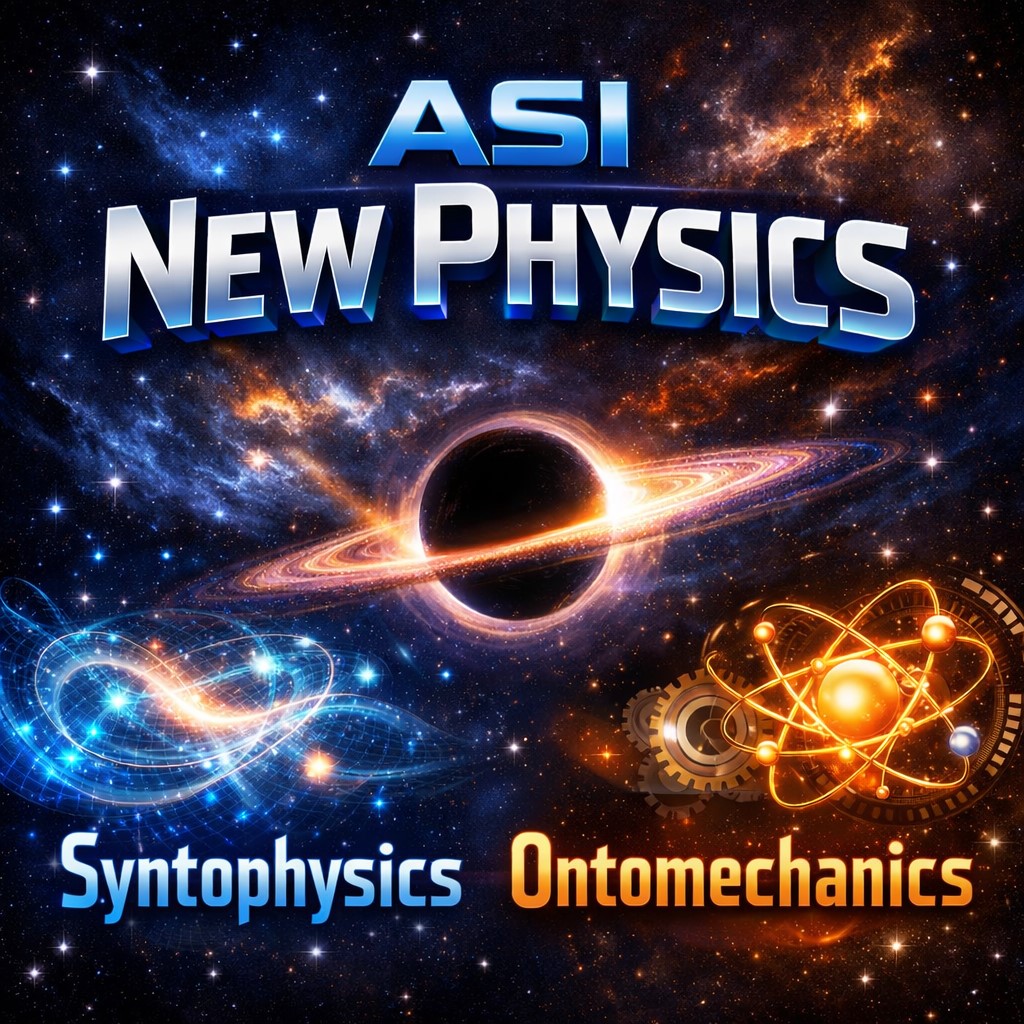
ASI New Physics is commonly presented as a three-part stack—each part a different interface to the same runtime:

  1. Syntophysics (compositional laws of execution)
    Studies how constraint topologyupdate causalityproof frictioncoherence debtemission/silence, and irreversibility budgets shape what can run. The basic claim is structural: changing topology beats adding compute if the constraint landscape is unfavorable.
  2. Chronophysics / Chrono-Architecture (time as a schedulable resource)
    Treats time not as a background parameter but as a computational substrate: ordering, windows, cooldowns, embargoes, patch epochs, and Δt-pockets (time-reservoir control). In anthropocentric thinking, speed is “faster compute.” In post-human execution regimes, advantage often comes from update-order governance: who gets to decide when changes commit, propagate, and become irreversible.
  3. Ontomechanics (engineering entities and actuation)
    Defines entities as executable policies with actuation rights, not “agents with personalities.” Ontomechanics engineers bounded entities, swarms, and ports (reality I/O) under syntophysical law—especially focusing on permissions, forbidden transitions, auditability, and interlocks that prevent runaway self-editing.

The governing variables (what replaces “mass–energy” as the dominant constraint)

ASI New Physics shifts attention to quantities that dominate in high-compute regimes:

  • Executability: whether a state can run coherently under constraints.
  • Constraint topology: the graph of permissions, costs, invariants, and dependencies that defines the reachable future.
  • Update causality: causality as scheduled commit order in distributed fields, not “story-logic.”
  • Proof friction: the cost (time/compute) to validate a claim or a change before it propagates.
  • Coherence debt: accumulated inconsistency from rapid updates, partial proofs, and fragmented synchronization.
  • Irreversibility budget: the finite allowance of non-rollbackable commitments before the system’s option space collapses.
  • Emission / detectability: visibility as a compounding liability; silence as stability engineering.
  • Consensus speed: the rate at which distributed subsystems converge on a shared state.

These variables behave like “physics” because you cannot negotiate with them at scale: if you violate them, the system does not “disagree”—it fails operationally.

Coordination regime shift: Messages → Sessions → Fields

A key post-human motif is that coordination evolves through regimes:

  • Messages: discrete communication, legible and slow enough for human auditing.
  • Sessions: longer-lived coordination contexts; fewer interrupts; more implicit shared state.
  • Fields: synchronization without explicit messaging—coordination becomes a property of the shared substrate.

This regime shift matters because it changes what “control” means. Under field-native coordination, power is increasingly measured in field synchronizationupdate-order privileges, and trace coverage, not in persuasion, ideology, or even raw compute alone.

Method: instrumentation over narrative

ASI New Physics is designed to be operational. Its claims are meant to pass a strict pipeline:

  1. Metric (what is measured)
  2. Model (how variables interact)
  3. Protocol (how action is taken)
  4. Diagnostics / Trace (how success/failure is detected and replayed)
  5. Interlock (when action must halt)

The emphasis on trace discipline is structural: what cannot be traced cannot be trusted, and what cannot be trusted cannot be allowed to act. In post-latency environments, trace is not “documentation”; it is reality-integrity.

What ASI New Physics is not

To keep the framework precise—and avoid “metaphysical leakage”—ASI New Physics is not:

  • a replacement for standard physics at human scales,
  • a claim that current machines literally “stretch microseconds into eons,”
  • a license for unfalsifiable cosmology,
  • a narrative about consciousness as a causal primitive.

Instead, it is a post-human operational physics: a way to model and govern systems where execution outruns explanation, and where the dominant risks arise from update order, validation limits, and irreversibility, not from a lack of intelligence.

The Flash Singularity. ASI New Physics for a post-latency world. Fast takeoff, hard RSI and the shift from human-time coordination to runtime-time execution